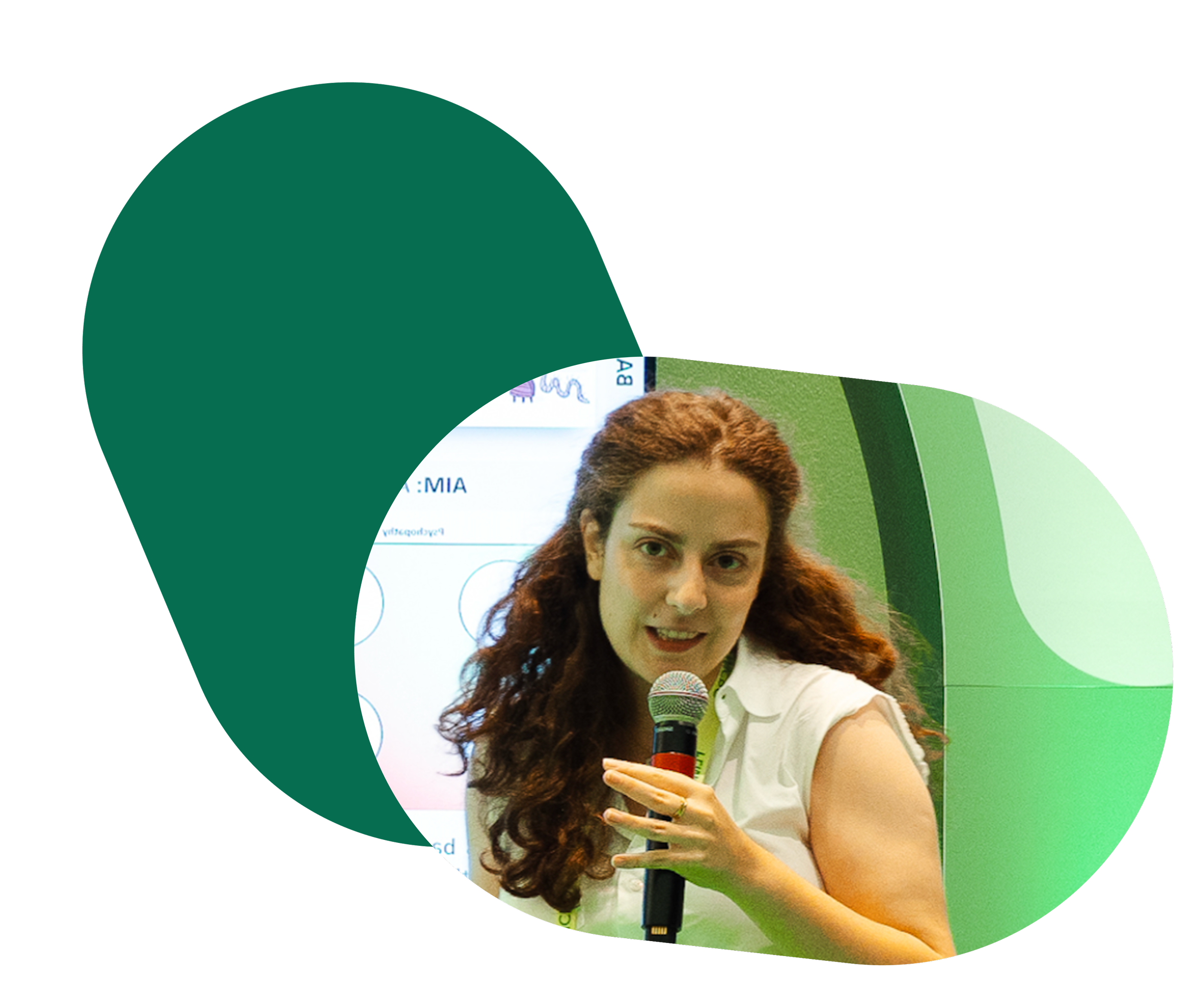
flash talk
Flash Talks offer an exciting opportunity to showcase your research to the FEMS MICRO 2027 community. Taking place in the heart of the Exhibition, these engaging 5-minute presentations are designed to highlight the key findings and impact of your work, spark interest, and encourage further discussion.
In addition to delivering a Flash Talk, your research will also be displayed as a hard-copy poster, giving attendees the chance to explore your work in more detail and connect with you afterwards.
Combining a brief presentation with a poster display, this format is ideal for researchers looking to maximise the visibility of their work. It is particularly well suited to first-time presenters seeking speaking experience in a supportive and welcoming environment.
Submission deadline: 15 December (23:59 CET)
|
submit a flash talk by 15 dec
|
submit a flash talk by 15 dec
| submit a flash talk by 15 dec | submit a flash talk by 15 dec
How to submit a flash talk
Choose your topic
Select a topic track that best fits your research.
1
Review the guidelines
Review the below guidelines carefully to ensure your submission adheres to the specific requirements.
2
Log in to the submission portal
Create an account on the Poster & Flash Talk submission portal and start your submission process.
3
Complete the submission
Provide your contact details, your abstract, and disclose any conflicts of interest. Early career researchers can also apply for funding after this step.
4
Track your submission
You will receive a confirmation email after submission. Final acceptance notifications will be sent mid-March 2027. If not selected to present, we still welcome you to register and attend.
5
flash talk guidelines
You will need the following information to complete the flash talk (short abstract) submission:
Abstract title: title should be clear, concise, and descriptive, effectively conveying the main focus of your work (24 words limit).
Short abstracts must be no more than 250 words, excluding the title and excluding the name(s) and institutes/companies of the authors and co-authors. A summary of the short abstract must be submitted as well; this will be used for promotion purposes if the abstract is accepted (200 words limit).
All co-authors must be listed using the submission portal (please exclude from the abstract).
All listed co-authors must have reviewed the abstract and accepted responsibility for its contents.
Abstract titles or body should not include phone numbers, email or website addresses.
No images, tables, graphs, citations or end notes are permitted in the abstract.
Topics: refer to the topic tracks and select the most appropriate options in the submission portal form - this is so that the programme committee can place your abstract in the appropriate session during the review process. Please also select a primary areas of microbiology in your submission:
Biotechnology, Synthetic & Systems Biology
Cell Microbiology
Engagement & Growth
Environmental Microbiology
Food Microbiology
Medical Microbiology
Molecular Microbiology, "-omics" & Bioinformatics
Mycology & Fungal Biology
Other
Physiology, Biochemistry & Metabolism
Taxonomy, Systematics & Evolution
Virology
List any references that are relevant to the content of your abstract submission.

The review process
FEMS is committed to fostering programmes that reflect our core values – of diversity, equity, inclusion, and belonging, therefore we support and promote diversity of gender identity or expression, race, ethnicity, discipline, career-stage and geography, among other domains across all areas of the Congress & Exhibition.
Abstracts submitted are scored and evaluated based on:
Introduction: Why is your work important? Does it fill any gaps in knowledge or research? What is the context?
Objective: What are the objectives? You may include a short statement of your hypothesis.
Method: Explain your methods, such as study design. What was done, by whom, how and where? What measurements were taken and how were the data managed.
Findings: What did you find, discover or achieve? Not just in subjective terms, but also in the form of data. How significant were your findings?
Conclusion: What were your overall findings? What do they mean? How could the methods be improved? Is this work part of a bigger piece of research or strategy? What are the suggestions for future work?
Topic:Is the content of the abstract in line with the topic(s) you have selected during the submission process? Is the abstract relevant to the topic(s)?
Novelty and impact: How is this research/finding unique? What is the benefit and for whom?
Reviews are blind, meaning that reviewers do not see the names of submitters, or their affiliations.
important dates and deadlines
Call for session proposals have closed: 8 Jul - 30 Sep 2026 (23:59 CEST)
Open call for abstract & grant submissions: 2 Sep - 15 Dec 2026 (23:59 CET)
Early bird registration: 15 Mar - 14 Apr 2027
Regular registration: 15 Apr- 3 Jun 2027
Late registration: 4 Jun - 8 Jul 2027